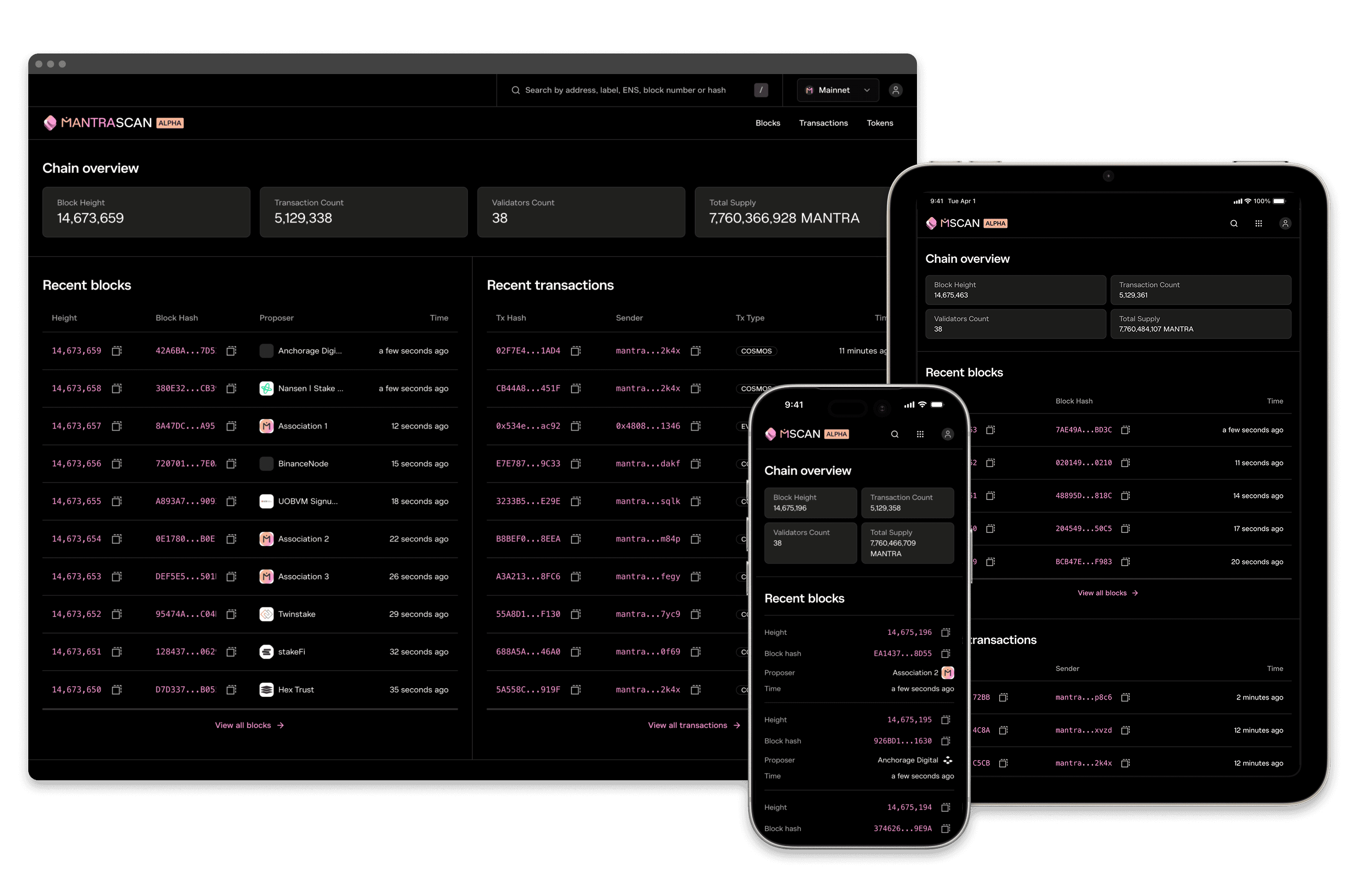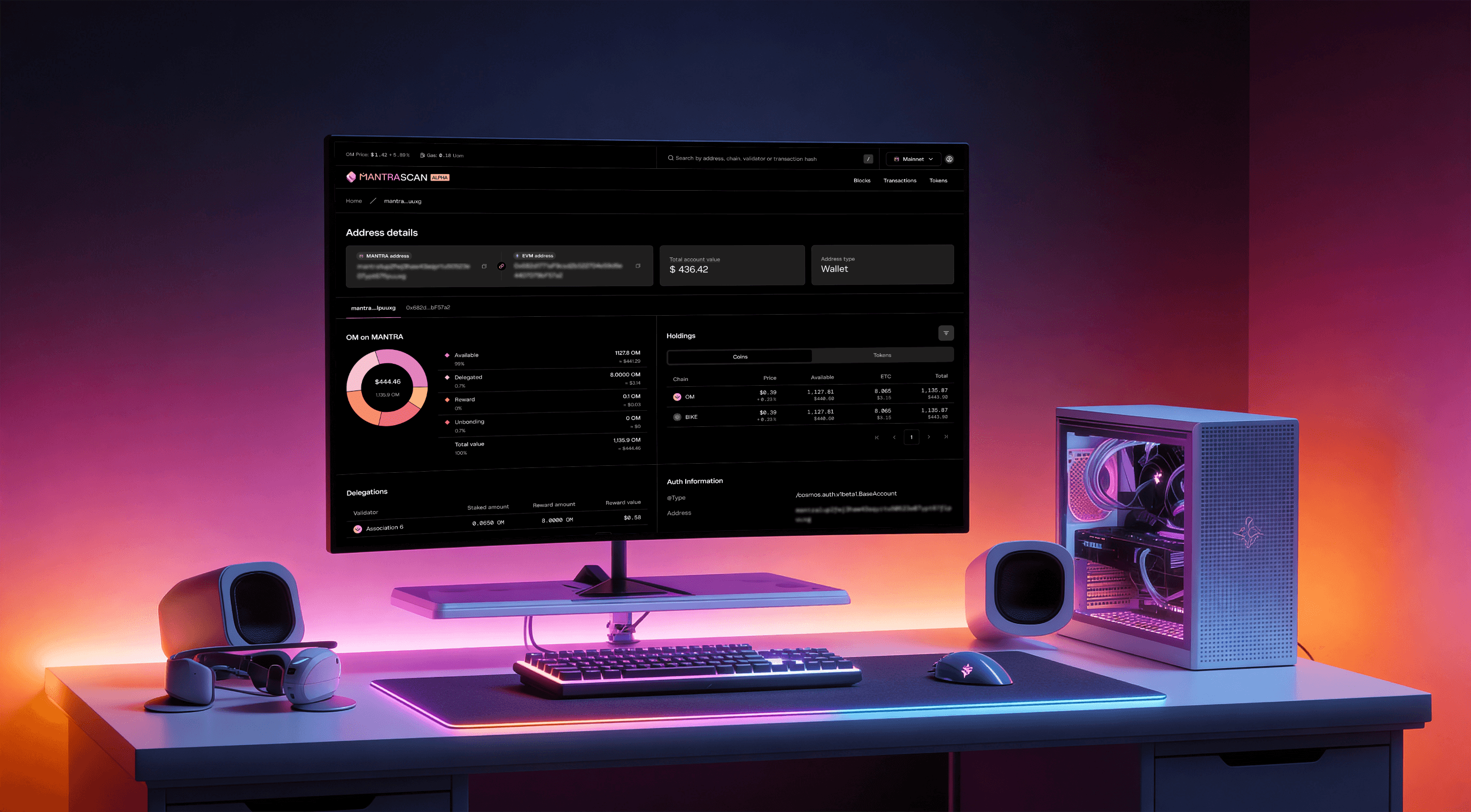
Designing a data-rich blockchain explorer for a growing ecosystem

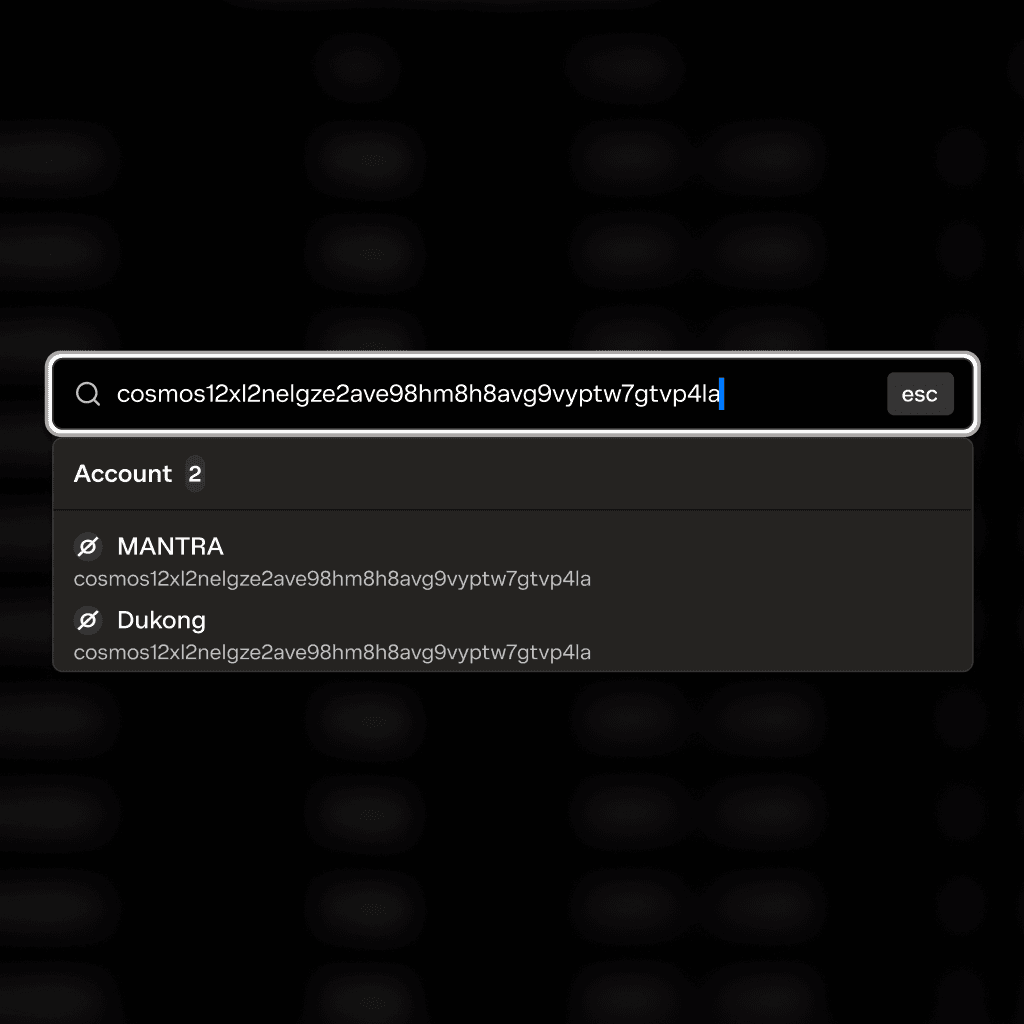
As MANTRA evolved into a dual Cosmos + EVM architecture, the need emerged for an in-house explorer that could surface linked wallet relationships across both environments, a capability that no existing tool offered out of the box.

Designed for engineers rather than casual investors, the product treated speed and functionality not as differentiators, but as fundamentals.
Client / Project

MANTRA / MANTRA Scan

Client / Project

MANTRA / MANTRA Scan

Platform

Responsive web

Platform

Responsive web

Role

UX UI

Role

UX UI

Year / Duration

2025 / 6 months

Year / Duration

2025 / 6 months

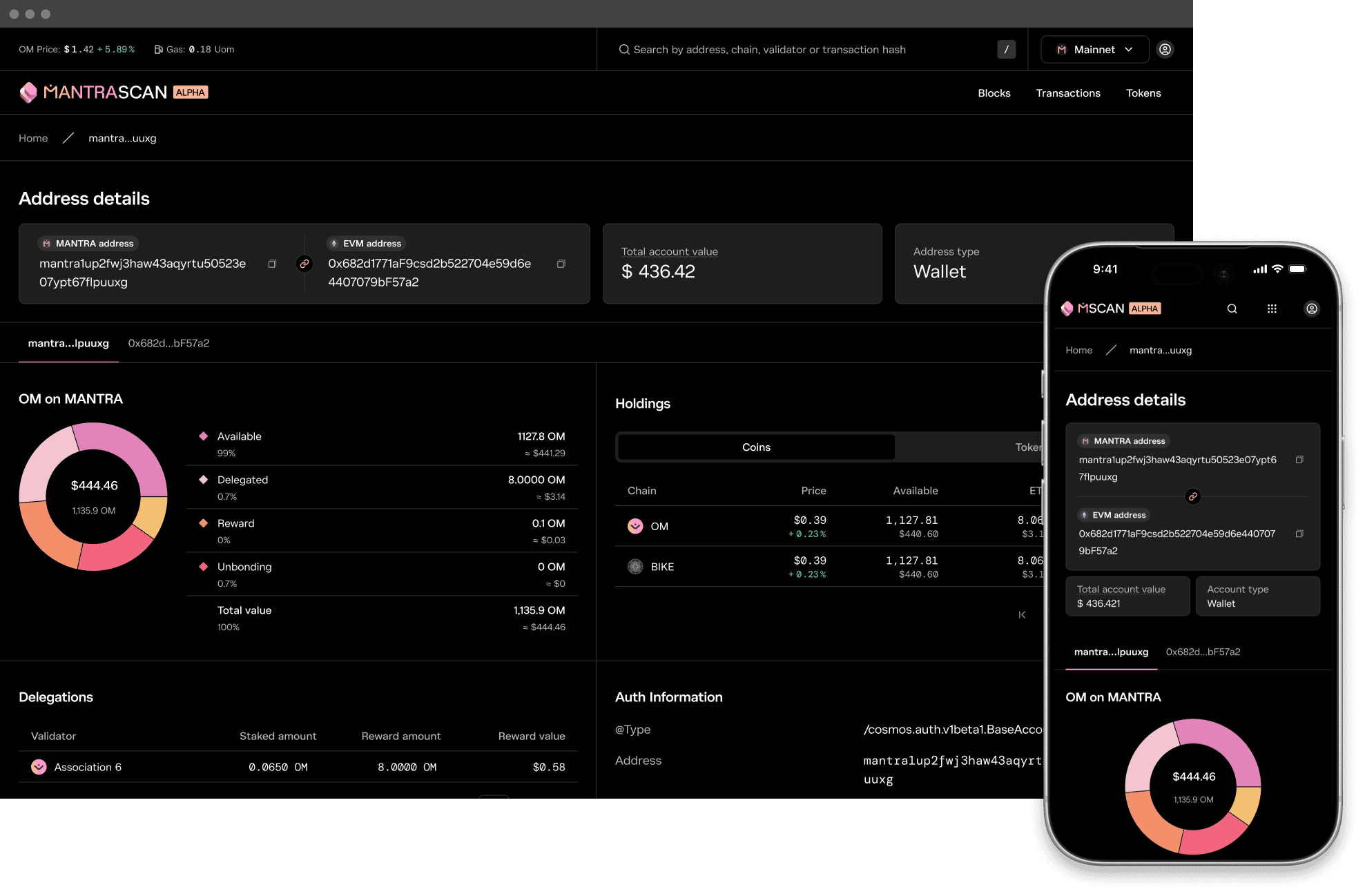
MANTRA Scan / Address page

Research

Blockchain explorers are inherently data-dense tools

The initial phase focused on analysing existing explorers and identifying common interaction patterns, alongside targeted interviews with smart contract engineers to understand their workflows and priorities.

Interviews conducted with engineers revealed a clear pattern: existing explorers were bloated, slow, and visually heavy, directly impacting workflow efficiency. A lean, high-performance interface was essential.

Minimal friction when navigating and extracting data

Little tolerance for unnecessary steps

Lightweight interface to boost performance

Copyability is a core behaviour

Problem statment

Some blockchain explorers fail to support efficiency-first workflows, where engineers need instant access, seamless copyability, and fast load times to interact with on-chain data. This results in unnecessary friction in time-sensitive, high-frequency tasks.

Some blockchain explorers fail to support efficiency-first workflows, where engineers need instant access, seamless copyability, and fast load times to interact with on-chain data. This results in unnecessary friction in time-sensitive, high-frequency tasks.

Some blockchain explorers fail to support efficiency-first workflows, where engineers need instant access, seamless copyability, and fast load times to interact with on-chain data. This results in unnecessary friction in time-sensitive, high-frequency tasks.

Design response

Efficiency-first, task-driven workflows

The interface was designed to support efficiency-first, task-driven workflows, where users need to quickly locate, interpret, and extract on-chain data with minimal friction.

Efficiency-first, task-driven workflows

The interface was designed to support efficiency-first, task-driven workflows, where users need to quickly locate, interpret, and extract on-chain data with minimal friction.

Efficiency-first, task-driven workflows

The interface was designed to support efficiency-first, task-driven workflows, where users need to quickly locate, interpret, and extract on-chain data with minimal friction.

Scannable, modular information architecture

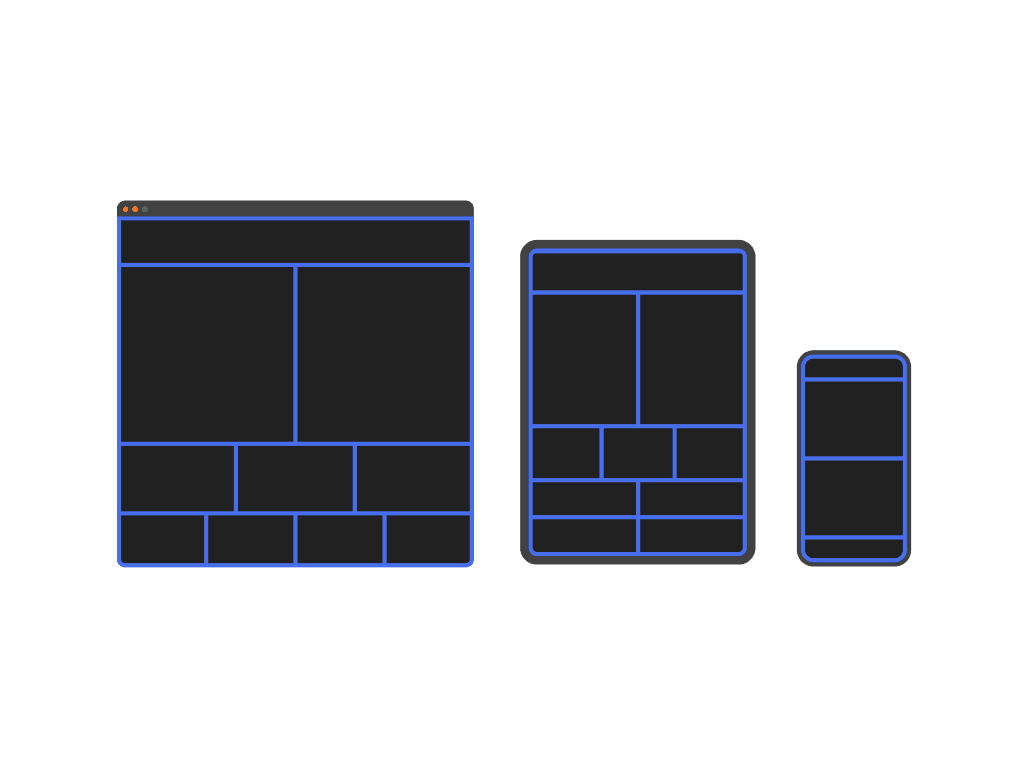
To enable rapid data access, information was structured into scannable, modular sections, allowing users to immediately identify key data points without navigating through dense or unstructured layouts.

Scannable, modular information architecture

To enable rapid data access, information was structured into scannable, modular sections, allowing users to immediately identify key data points without navigating through dense or unstructured layouts.

Scannable, modular information architecture

To enable rapid data access, information was structured into scannable, modular sections, allowing users to immediately identify key data points without navigating through dense or unstructured layouts.

One-click data access at point of use

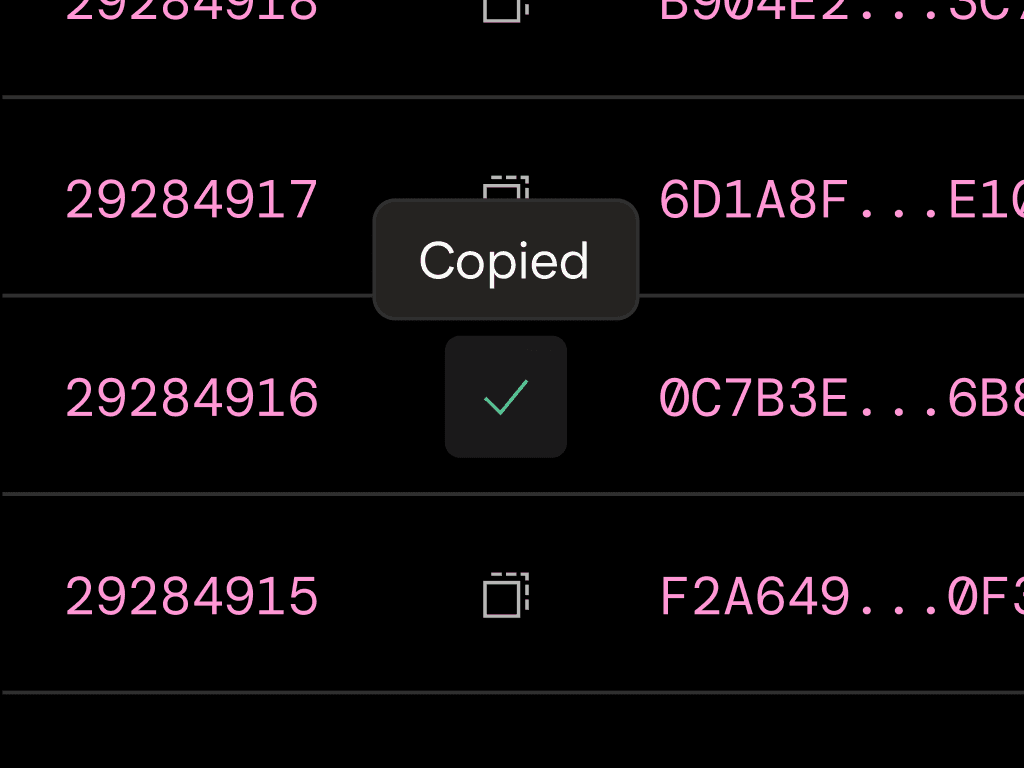
Given the frequency of data extraction in developer workflows, copy interactions were embedded directly at the point of use, enabling one-click access to addresses, hashes, and values without interruption.

One-click data access at point of use

Given the frequency of data extraction in developer workflows, copy interactions were embedded directly at the point of use, enabling one-click access to addresses, hashes, and values without interruption.

One-click data access at point of use

Given the frequency of data extraction in developer workflows, copy interactions were embedded directly at the point of use, enabling one-click access to addresses, hashes, and values without interruption.

Function-first, distraction-free interface

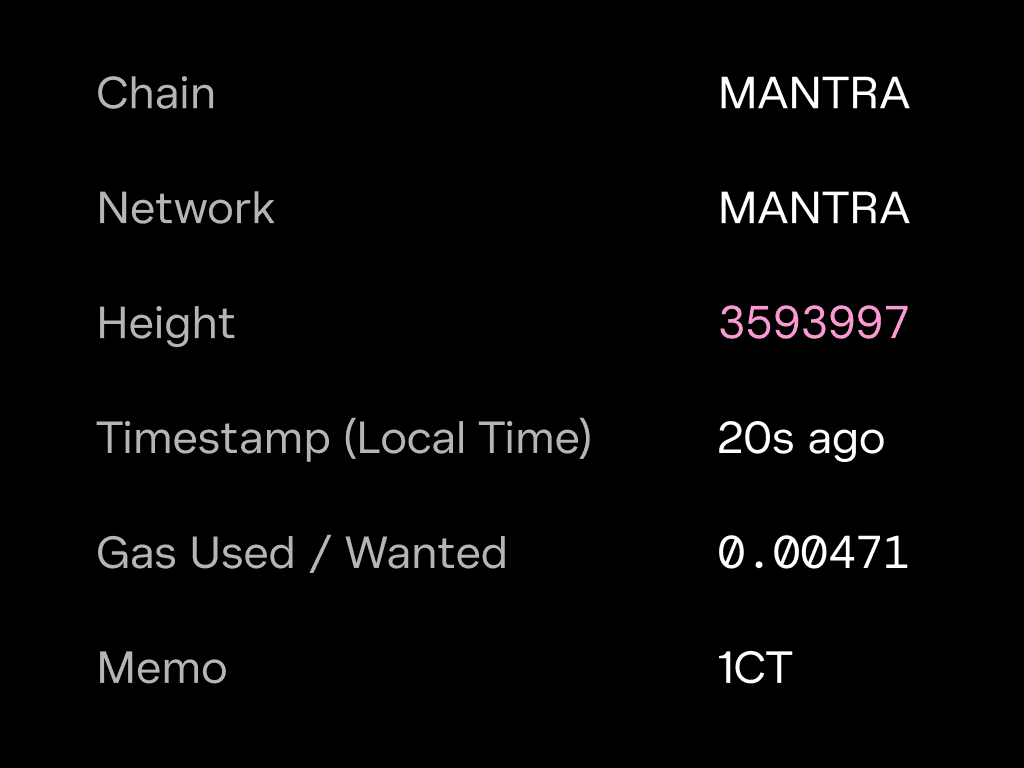
The visual design prioritised function over form, removing non-essential styling and avoiding graphic-heavy elements to maintain clarity and reduce cognitive load during high-frequency use.

Function-first, distraction-free interface

The visual design prioritised function over form, removing non-essential styling and avoiding graphic-heavy elements to maintain clarity and reduce cognitive load during high-frequency use.

Function-first, distraction-free interface

The visual design prioritised function over form, removing non-essential styling and avoiding graphic-heavy elements to maintain clarity and reduce cognitive load during high-frequency use.

MANTRA Scan / Main page

© 2026